





Speak to one of our experts
Our insulation experts are ready to discuss the best options to help you have a comfortable, efficient home.
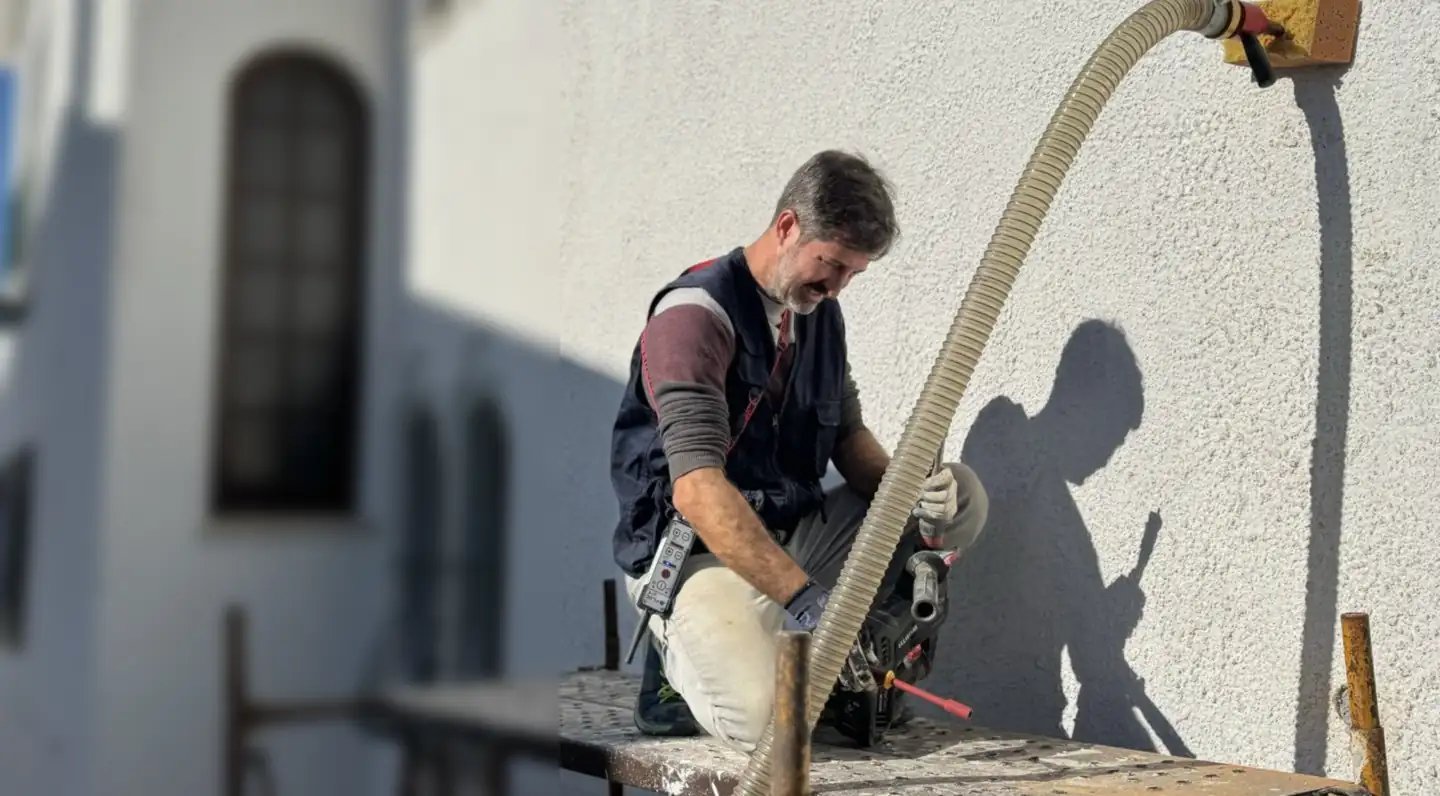
Double walls
All three insulate. They differ in fire, moisture and how easy they are to fix later. We use blown mineral wool, which does not burn. See the comparison ↓
By David Francisco, civil engineer at EnergyEase · Updated 25 October 2026
Free and without obligation
Book a visit with an inspection camera
We look inside the wall, tell you what works and send a written quote with the final price.
Rather talk? 210 270 937 or WhatsApp
We use your details only to plan the visit and send your quote.
5.0 on Google
from 55 reviews
Free technical visit
with an inspection camera
Published prices
per m², VAT included
Written quote
free, with no obligation
Comparison
Short answer: closed-cell polyurethane foam insulates the most per centimetre. Blown mineral wool is the only one of the three that does not burn (class A1), and it goes in loose, with no glue.
First step: do you really have a cavity? Take the 1-minute test →Tap a topic to compare:
Polyurethane foam
injected, closed-cell
EPS beads
loose or bonded
Blown mineral wool
glass wool flakes
What we useHow well it insulatesλ: the lower, the better
Polyurethane foamClosed-cell: λ about 0.027 W/m·K, so it insulates the most per centimetre. Open-cell foam insulates much less.
EPS beadsλ 0.032 to 0.040 W/m·K (grey to white beads).
Blown mineral woolλ 0.033 (Supafil Cavity 033, the one we use) to 0.034 W/m·K.
In a cavity, the thickness is the same for all three: the width of the cavity.
How it is installed
Polyurethane foamTwo liquids mixed in the gun nozzle. The foam expands and sticks to both leaves of the wall.
EPS beadsBeads that flow very easily and need fewer holes. They can have a glue that binds them.
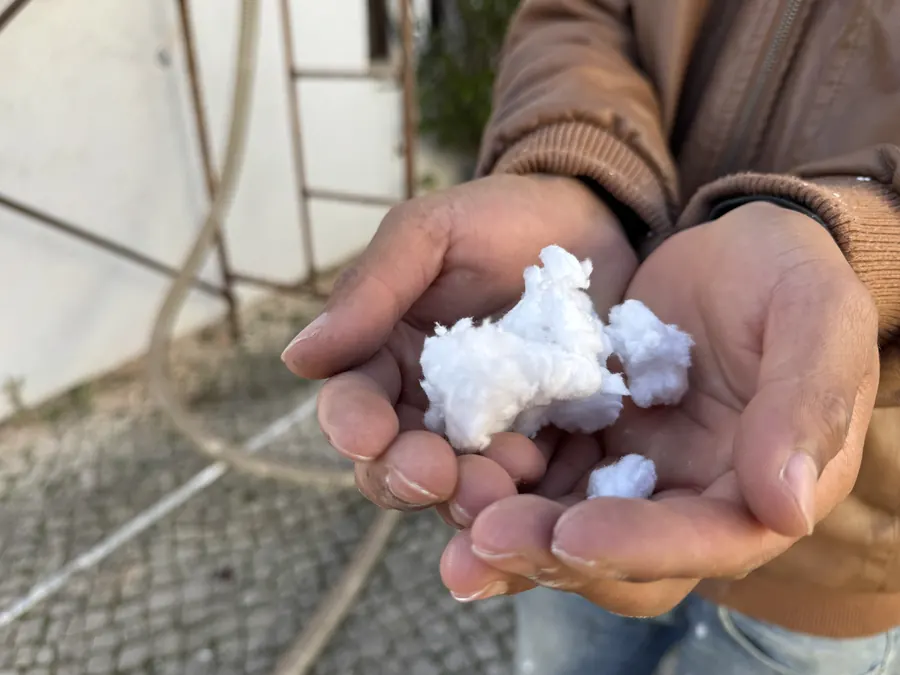
Blown mineral woolFlakes blown in through the holes, from the bottom up, until the cavity is full.
There is also polyurethane granulate (shredded foam). It flows less easily than beads. Ask for the data sheet with the λ and the Euroclass.
Moisture
Polyurethane foamClosed-cell foam takes up almost no water.
EPS beadsEPS is a plastic and takes up almost no water.
Blown mineral woolContains an additive that repels water.
For all three: a damp problem in the wall must be solved before filling.
Fixing it later
Polyurethane foamDifficult. It sticks to the bricks on both sides.
EPS beadsLoose beads can run out of openings in the wall. Bonded beads stick to each other.
Blown mineral woolLoose flakes, no glue. A gap can be topped up through a new hole.
FireEuroclass, EN 13501-1
Polyurethane foamCombustible. In the data sheets we checked: class E, or no class declared.
EPS beadsCombustible: class E.
Blown mineral woolNon-combustible: class A1, the best class.
In a double wall that is closed at the top, foam and EPS are not considered an unacceptable fire risk. They should be kept away from hot flues.
Material
Polyurethane foamA plastic made on site from isocyanates and polyol. Installers need mandatory training in the EU.
EPS beadsExpanded polystyrene (EPS), a plastic. It should not touch PVC-sheathed electric cables, which would turn brittle.
Blown mineral woolGlass wool, made largely from recycled glass. We use Knauf Supafil 033.
There are other foams, such as urea-formaldehyde, with different values and rules. Always ask for the data sheet.
Sources: Energy Saving Trust guide with BRE (CE252, UK, 2007); standard EN 13501-1; ETA-18/0707 and Knauf Supafil Cavity 033 data sheet; BPF EPS Group (bead λ); manufacturer data sheets for PUR foam and bonded EPS; Regulation (EU) 2020/1149.
Our choice
Foam insulates well and has its uses. To fill the walls of a home, we chose mineral wool for three reasons.
It does not burn
It is class A1, the best reaction-to-fire class.
It does not stick
If the wall ever needs opening or a gap needs topping up, it is simple.
No chemicals mixed on site
The wool comes ready from the factory. We only blow it into the wall.
EPS beads have strong points too: they flow very well and need fewer holes. At the visit we tell you frankly what works for your wall.
Before you decide
Price
What changes the price
We do not give prices for foam or beads, because we do not install them.
See prices for every solution →Blown mineral wool
€20–45/m²
VAT included, per m² of wall
Done in 1 to 3 days for a typical house
Get my free quoteor call 210 270 937
Google reviews
5.0
from 55 Google reviews
Get my free quote“Good evening. Four months after we insulated the walls and the attic, the thermal comfort in the house has improved a lot.
As for the process, I can only say that everyone involved was more professional than average, very helpful and quick in carrying out the work, meeting the agreed deadlines.
I recommend them 100%.
Best regards to the whole team, and in the future I will not hesitate to contact you again.”Mario C. · Google, translated from Portuguese
“The team were prompt, knowledgeable, efficient and polite, working around a building site and accommodative to our issues. Great price and service and would recommend to anyone who, like us, had a house with no insulation!! Thanks EnergyEase!!”
SRG77 · Google
FAQ
Another question? Call us on 210 270 937 or message us on WhatsApp.
It depends on what matters most to you. All three insulate. Closed-cell polyurethane foam insulates the most per centimetre. Mineral wool is the only one of the three that does not burn (class A1), and it goes in loose, with no glue. We use water-repellent mineral wool.
No. In walls we use blown mineral wool. Foam insulates well and has its uses. We chose wool because it does not burn, does not stick and no chemicals are mixed on site.
The foam is made with diisocyanates, which can cause skin and respiratory allergies, including asthma. The risk is mainly during application and while the foam cures. That is why, since 24 August 2023, anyone using them professionally in the EU must have mandatory training. Ask the installer about their training and how long you should stay out of the house.
Loose beads can run out of openings in the wall. That is why they can have a glue that binds them inside the cavity.
With blown mineral wool, €20 to 45 per m² of wall, VAT included, in 1 to 3 days for a typical house. Closing the holes is included. See also how much insulation costs.
Take the 1-minute test: the thickness of the wall and the year of the building already give a good clue. You know for sure at the free visit, when we look inside the wall with an inspection camera.
Keep reading

Visits in Lisbon, Cascais, Oeiras, Sintra, Almada and Setúbal
Free technical visit, no obligation
Don't just take our word for it - hear from those who have experienced the EnergyEase difference.


