


Speak to one of our experts
Our insulation experts are ready to discuss the best options to help you have a comfortable, efficient home.

External wall insulation
Real prices from projects we finished in 2025 and 2026, honest timelines, and a straight answer on whether your house needs capoto or whether blown‑in does the job for less.
By David Francisco, civil engineer at EnergyEase · Updated 18 October 2026
Free and without obligation
What would your façade cost?
We measure the façade, check for a cavity, and quote the route that fits. Reply within 24 hours.
Rather talk? 210 270 937 or WhatsApp
We use your details only to plan the visit and send your quote.
A house we insulated
5.0 on Google
from 54 reviews
Free technical visit
we measure on site
Real prices, published
from finished projects
Written quote
usually within 48 h
The basics
Capoto is the Portuguese name for ETICS, an external thermal insulation composite system. Insulation boards are bonded and fixed to the outside of the wall, covered with a reinforced base coat, and finished with a render in the colour you choose.
Because it wraps the building from the outside, it covers the pillars, beams and slab edges along with the wall itself. Those are the places where heat escapes even in houses that are otherwise insulated.
It matters here more than most people think: about 69% of Portuguese homes were built before the first thermal regulation of 1990, and most of them have no wall insulation at all.

Illustration, not to scale
The layers of a capoto system, from the wall you already have to the finish. Photos from one of our own jobs.
Your existing wall
Brick, block or stone. It stays as it is.
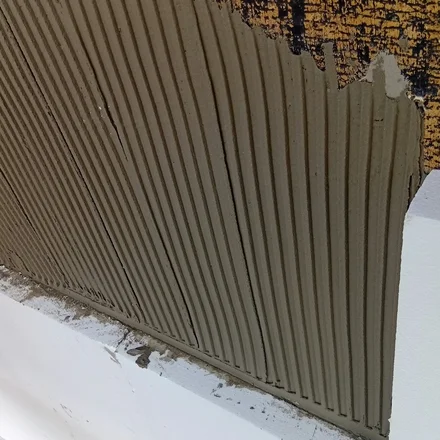
Adhesive mortar
Bonds the boards to the wall.
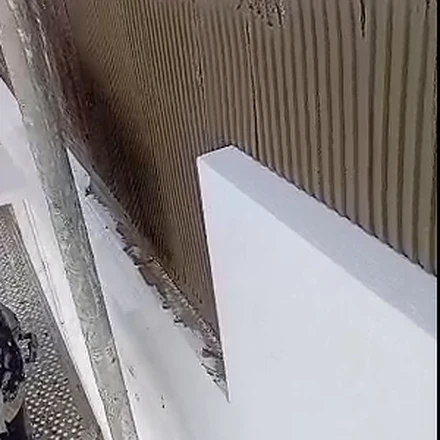
Insulation boards
EPS as standard, rock wool on request. From 20 to 100 mm thick.
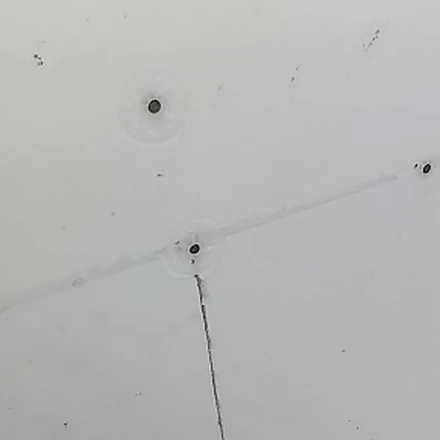
Anchors
Fix the boards mechanically into the wall.
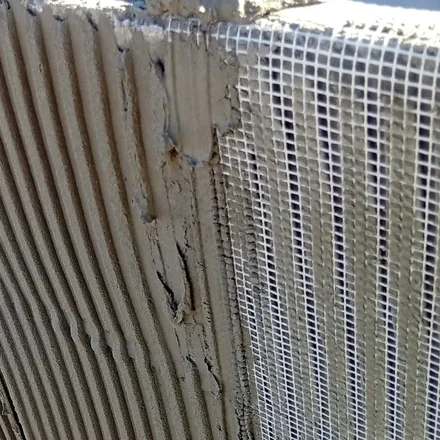
Base coat with glass-fibre mesh
Reinforces the surface against cracks.
Finish render
The new outside of your house, in the colour you choose.
Why it is the most complete: the boards run on over pillars, beams and slab edges, so the cold bridges in the wall are covered too.
Before you decide
Capoto is the best thermal solution a house can get. It is also the biggest job on the list. Both are true, and you should know both.
No cold bridges left
Pillars, beams and slab edges are covered along with the wall.
A new façade in the same job
At the end, you have new render in the colour of your choice.
Works on almost any wall
Brick, block, concrete or stone. We check the condition of the wall first.
Built to last
The European assessment document for ETICS assumes 25 years of service, with an occasional clean and small repairs.
Budget
Roughly two to three times the price of blown‑in insulation.
Time
Over a month on a 200 m² façade, with scaffolding the whole time.
Approval
In a building, the owners' assembly has to approve it, by a simple or a two-thirds majority depending on the work.
None of these makes capoto a bad choice. But they explain why we also offer an alternative.
Real prices
€70–100
per m², VAT, scaffolding and painting included
Prices checked October 2026
Many capoto price tables online still show figures from 2020 and 2021. Ours are full contract totals from projects we finished in 2025 and 2026.
Why do small façades cost more per m²? Scaffolding, site set-up and transport barely depend on the area, so on a small façade that fixed cost weighs much more per m².
| Municipality | Façade | Total | Per m² |
|---|---|---|---|
| Oeiras | 225 m² | €17,172 | €76 |
| Cascais | 180 m² | €13,356 | €74 |
| Cascais | 35 m² | €3,710 | €106 |
| Cascais | 17 m² | €2,162 | €127 |
Completed in 2025 and 2026. Signed contract totals, municipality only for privacy.
Get the price for your façade →Two routes
Capoto is the most complete. When your wall already has a cavity, blown‑in is the cost-effective route. This is how they compare on a typical house.
| Comparison | The most complete Capoto (ETICS) | The cost-effective route Blown‑in insulation |
|---|---|---|
| How it works | Boards fixed to the outside, under a new render | Mineral wool or cork blown into an existing cavity |
| What it insulates | The whole façade, including pillars, beams and slab edges | The wall itself |
| Price per m², VAT incl. | €70–100 | €20–45 |
| Time, 200 m² façade | Over a month | About 3 days |
| Your façade | New render and a new colour | Unchanged: small holes sealed, ready to paint |
| Works on | Almost any wall: brick, block, concrete or stone | Cavity walls, false ceilings and attic floors |
| Best when | The wall is solid, or the façade needs renovating anyway | Budget or time matters, or you insulate unit by unit instead of the whole façade |
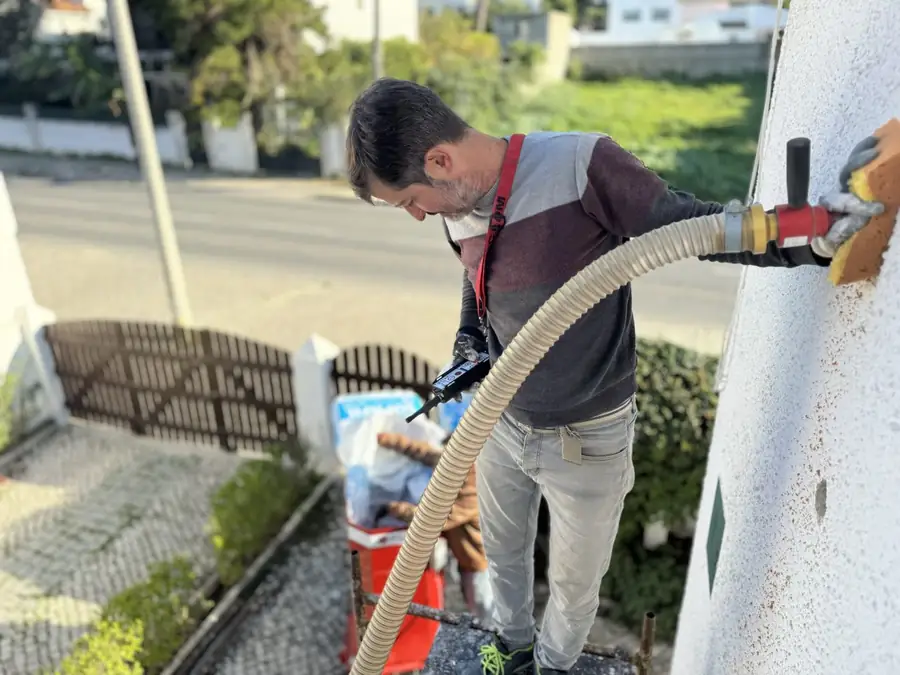
Real quotes, one house in Cascais
Capoto, façade
€15,158
Blown‑in, same house
€5,724
We quoted both, each ready to paint. The walls had a cavity, so the owner chose blown‑in: well under half the price, and done in days instead of weeks.
We measure the façade, check for a cavity and tell you what makes sense in your case. The visit is free, and the written quote usually follows within 48 hours.
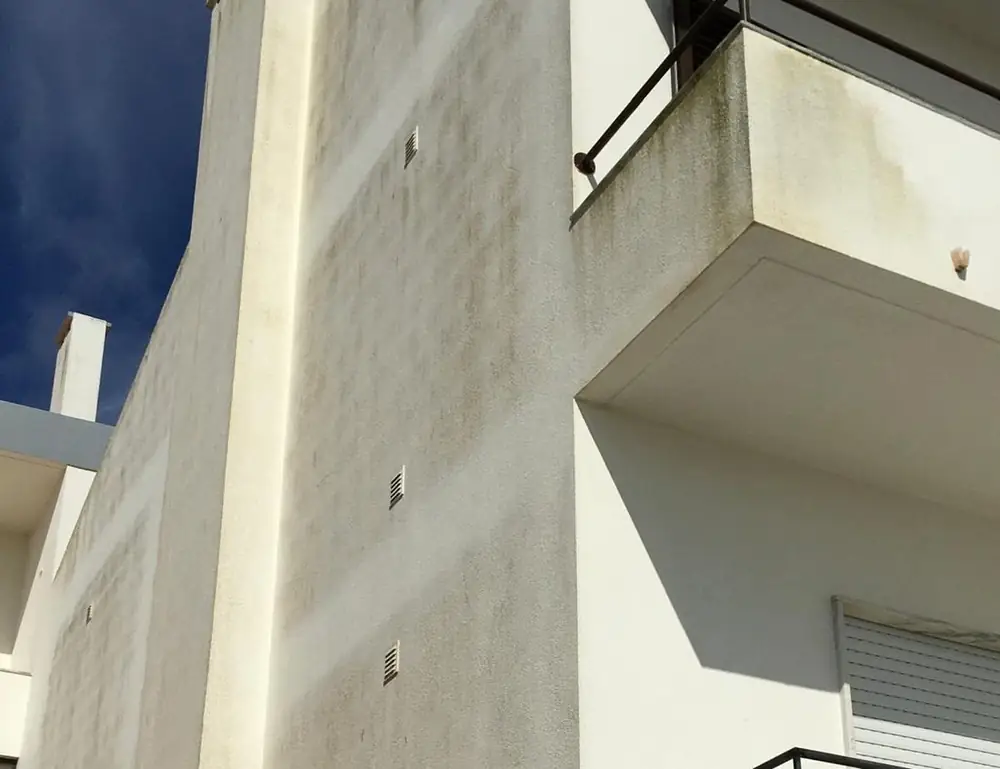
Example · two kinds of wall, one house
Many houses have two kinds of wall: part with a usable cavity, part solid. Wrapping everything from outside is the textbook answer, but it costs far more and keeps the scaffolding up for weeks longer.
The alternative is to split it: capoto on the solid façades, blown‑in where the cavity allows it. A budget within reach, with no wall left uninsulated.
Solid wall
Capoto
With a cavity
Blown‑in
Result
Every wall insulated
Materials
Most installers in Portugal only offer EPS. We leave the choice to you, because at the same thickness both boards insulate practically the same. What separates them is fire, moisture and noise.
Reference: Secil ISOVIT Painel EPS 100
View the data sheet
Expanded polystyrene, the board most ETICS systems in Portugal are built on. Light, stable, and the best balance of performance and cost.
Reference: Knauf Insulation Smart Wall FKD‑S Thermal
View the product page
A rigid rock wool board made for ETICS façades. At the same thickness it insulates practically the same as EPS, but it does not burn, the wall can breathe, and it does more against outside noise.
So which one?
We put rock wool forward when fire behaviour matters, on taller buildings or close to a boundary, and when the wall needs to stay vapour-open. On noise we are careful: on most houses the windows, not the wall, decide how much you hear, so a different board only helps once the glazing is up to it. Otherwise EPS does the job for less. We decide it with you at the technical visit.
The process
Free
Technical visit
We measure the façade, check for a cavity and the window reveals. Your written quote usually follows within 48 hours.
First days
Scaffolding and prep
Erection, cleaning the substrate and repairing cracks.
3 to 4 weeks
Boards and render
Boards bonded and fixed, mesh, then render coats with drying time between them.
Final days
Colour and clear-out
Finish in the colour you chose, cleaning, scaffolding removed.
Google reviews
5.0
from 54 Google reviews
“Excellent service from beginning to end! Perfect communication throughout and the team did an excellent job, on time and even below initial budget!”
Andre L. · Google review
“Prompt, knowledgeable, efficient and polite. Great price and service, and I would recommend them to anyone who, like us, had a house with no insulation.”
SRG77 · Google review
“Communication was transparent, easy and complete from the very first contact. […] The work was carried out within the estimated schedule and timeframe.”
Tomás F. · Google review, translated from Portuguese
FAQ
Another question? Call us on 210 270 937. We reply within 24 hours.
As a rule, thicker insulates better, and our projects run from 20 to 100 mm. The limit is usually visual: board and render add their full thickness to the façade, so past a certain point the wall stands proud of the window frames. Owners who want the finish flush with the frames often choose a thinner board on purpose. We measure the reveals at the visit and tell you where that line sits on your house.
The European assessment document for ETICS (EAD 040083) assumes a service life of 25 years. That is a design assumption, not a guarantee, and it depends on upkeep: an occasional clean and repairing small cracks before water gets in. The warranty on the materials depends on the manufacturer.
If your walls are solid, or the façade needs new render anyway, yes: it is the most complete way to insulate a house. Judge it on comfort rather than on payback. In the Portuguese climate, energy savings alone take a long time to repay a façade. What you notice straight away is a house that stays warmer in winter and cooler in summer, without cold spots on the inside of the walls.
In an apartment building, changing the façade needs the approval of the owners' assembly, by a simple or a two-thirds majority depending on the work. We prepare the quote in the format the assembly needs, with the area broken down per façade. Blowing insulation into the wall cavity leaves the façade as it is, which often makes the process simpler.
Often not. In historic areas such as Alfama, Mouraria, Bairro Alto, Sintra-vila or Cascais-vila, changes to the façade are restricted. There, the usual route is to insulate from the inside: blown‑in where the wall has a cavity, or an insulated lining wall where it does not.
Yes, and it is common. Capoto on the solid façades, blown‑in where the wall has a cavity. That is the mixed solution in the example above.
Blown‑in insulation: mineral wool blown into the cavity of a cavity wall, without touching the façade. It costs about half the price of capoto, or less, and is done in days. Capoto remains the most complete solution, because it wraps the whole façade. We compare the options, with prices and timings, in our guide to alternatives to capoto.
Keep reading
Blown‑in insulation
The cost-effective alternative when your wall has a cavity.
Read more →
Capoto or cavity wall insulation?
How to tell which one your walls need.
Read more →
What does insulation cost in Portugal?
Estimate your price per technique in the calculator.
Read more →
Finished projects
Photos and details from houses we insulated.
Read more →

We apply capoto in Lisbon, Cascais, Oeiras, Sintra, Almada and Setúbal
Free visit, quote usually within 48 hours
Don't just take our word for it - hear from those who have experienced the EnergyEase difference.


