





Speak to one of our experts
Our insulation experts are ready to discuss the best options to help you have a comfortable, efficient home.

Inside and outside walls
There are three ways to insulate the walls of a house: in the cavity, from the outside or from the inside. The right one depends on the wall you have, and prices run from €20/m² (blown-in) to €150/m² (lining wall), VAT included. We show you how to recognise yours, what each option cost in projects we finished, and what changes in your home.
By David Francisco, civil engineer at EnergyEase · Updated 19 October 2026
Free and without obligation
Which insulation is right for your walls?
We check whether your walls have a cavity and quote the option that makes sense. Reply within 24 hours.
Rather talk? 210 270 937 or WhatsApp
We use your details only to plan the visit and send your quote.
Our team filling a cavity wall
5.0 on Google
from 54 reviews
Free technical visit
we check the wall on site
Real prices, published
from finished projects
Written quote
usually within 48 h
Step one
The wall decides the solution. Pick the one that looks like yours and see what we do.
How to recognise it: Walls of about 30 to 40 cm in total, which you can measure at a window or door. It is the most common wall in houses built from the 1960s and 70s onwards.

We drill from outside or inside, depending on access. At the end, we seal the holes and the wall is ready to paint: by you, or by us, quoted separately.
How blown-in insulation works →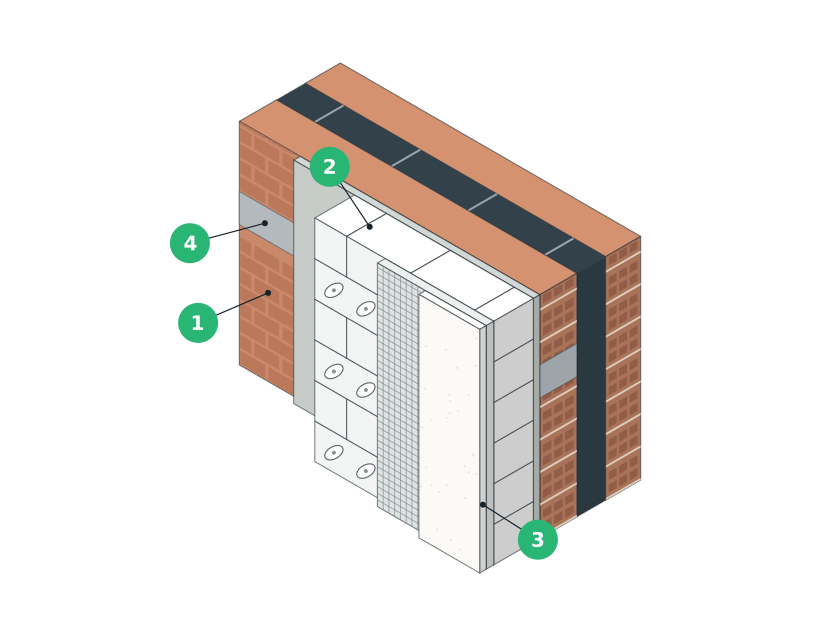
Scaffolding and painting included. It makes sense when the façade needs work anyway, or when you also want to insulate pillars, beams and slab edges.
Capoto: price per m² and timings →
Painting included. You lose some space, from about 5 cm per wall and more if you want more insulation, but you need no approval from the building and can go room by room. On a cavity wall, blown-in is usually cheaper.
Lining walls and ceilings →How to recognise it: No air gap and thinner, often 20 to 25 cm. You find it in block walls, extensions and some older houses.
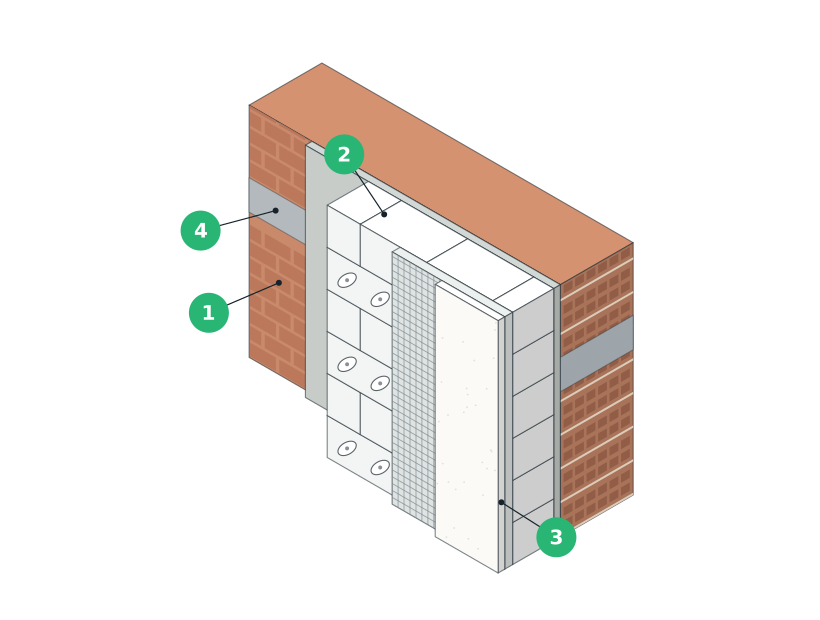
Scaffolding and painting included. It is the most complete option, because it also covers pillars, beams and slab edges.
Capoto: price per m² and timings →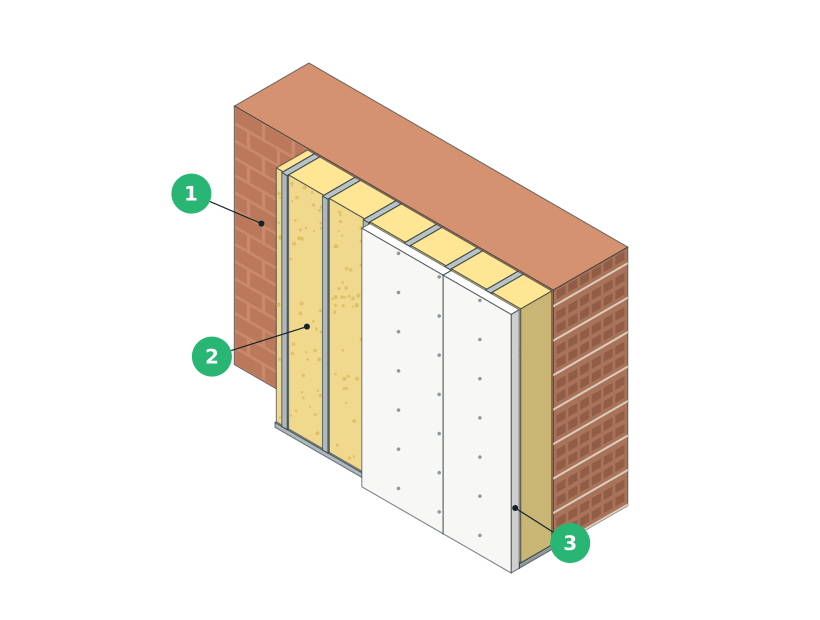
Painting included. You lose some space, from about 5 cm per wall and more if you want more insulation, but you need no approval from the building and can go room by room.
Lining walls and ceilings →How to recognise it: Thick walls, often 40 cm or more, in old houses and historic centres.

Painting included. You lose some space, from about 5 cm per wall and more if you want more insulation, but you need no approval from the building and can go room by room.
Lining walls and ceilings →
Scaffolding and painting included. At the visit we check the state of the stone and whether the façade may be changed.
Capoto: price per m² and timings →Cannot touch the façade, for example in an apartment building? On a cavity wall we can also blow in from inside; on other walls, the answer is a lining wall.
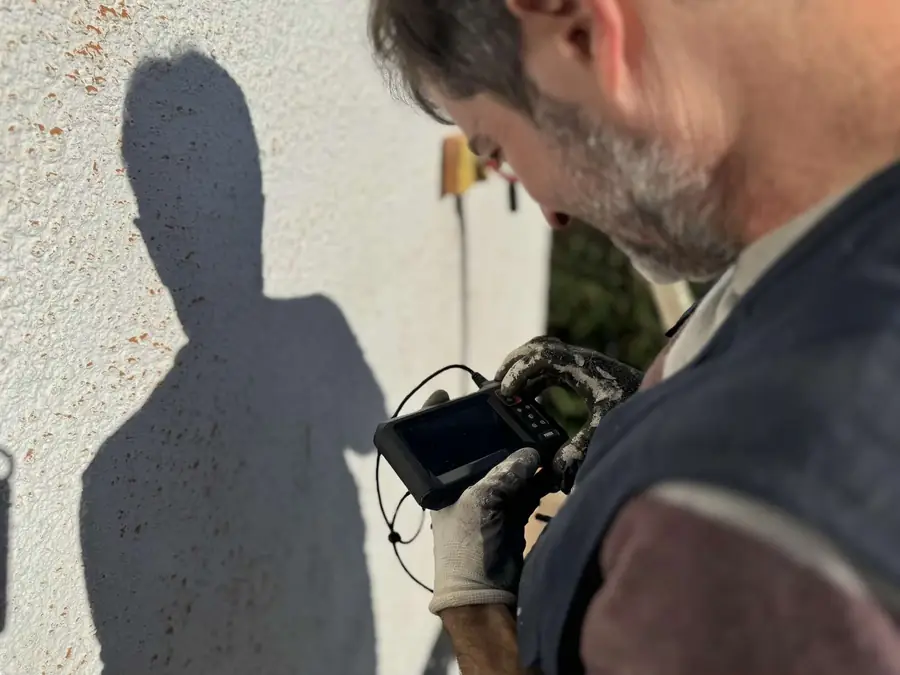
Not sure which one you have?
That is normal, and many houses have more than one kind of wall. At the free technical visit we check whether there is a cavity, and what state it is in, with a small inspection camera.
Book the free visit →Real prices
Prices per m² from projects we finished in 2025 and 2026, VAT included. Alongside, what changes in your home with each option.
| Comparison | In the cavity Blown-in insulation |
Outside Capoto (ETICS) |
Inside Insulated lining wall |
|---|---|---|---|
| Typical job | 30 to 120 m² of wall | The whole façade | One or two rooms, 8 to 20 m²; from 40 m², the price per m² drops |
| Price per m² incl. VAT, typical house | €20–45 | €70–100 | €70–150 |
| Duration, typical house | 1 to 3 days | 3 to 6 weeks | 3 to 7 days |
| What changes | Small holes, sealed at the end. The façade stays. | The façade gets new render and colour. Nothing changes inside. | Each wall moves in a few centimetres, from 5 cm; sockets and skirting boards move. The façade stays. |
| What it insulates | The wall, through its cavity | The whole façade, including pillars, beams and slab edges | The inside face of the wall |
| Best when | The wall has a cavity and budget or time matter | The wall is solid, or the façade needs work anyway | You cannot touch the façade, or want to insulate only some rooms |
In the cavity
Blown-in insulation
Outside
Capoto (ETICS)
Inside
Insulated lining wall
For the same area, a lining wall costs about 2 to 2.5 times as much as blown-in: the price per m² falls as the job gets bigger. From 40 m² of wall, a lining wall starts at €70–120/m². Capoto includes scaffolding and painting. Lining wall excludes painting; its price includes the insulation, so it does not compare with a plain plasterboard partition. On small areas the price per m² goes up, because travel and set-up hardly depend on the area.
Finished projects
€38
per m², the median, VAT included
67 projects from 2025 and 2026, checked October 2026
The more wall, the lower the m² price: a 1 or 2-bedroom flat usually comes to €1,050 to €1,600, a house with about 100 m² of wall €2,000 to €3,500.
Why does it vary so much?Travel, set-up and the machine cost almost the same on a 20 or a 200 m² wall. The width of the cavity counts too: a wider gap takes more material.
| Municipality | Wall | Total | Per m² |
|---|---|---|---|
| Mafra | 37 m² | €1,255 | €34 |
| Almada | 45 m² | €1,670 | €37 |
| Lisbon | 54 m² | €1,942 | €36 |
| Odivelas | 62 m² | €2,480 | €40 |
| Sintra | 86 m² | €3,063 | €36 |
| Cascais | 105 m² | €3,896 | €37 |
| Cascais | 175 m² | €5,380 | €31 |
| Lisbon | 178 m² | €3,208 | €18 |
Mineral wool blown into cavity walls, projects finished in 2025 and 2026. Totals of the accepted quotes, VAT included. For privacy, municipality only.
Get the price for your walls →“I contacted EnergyEase to blow thermal insulation into the walls of my apartment that face the outside.
Communication was transparent, easy and complete from the very first contact, and all my questions throughout the project were properly answered.
All the documents for the job (quote, technical data sheets of the materials, intervention report, invoices and receipts) were duly handed over to me.
The work was carried out within the estimated hours and timeframe and, once it was finished, the technicians cleaned up the debris both in the apartment and in the entrance hall of the building's common areas.
I am writing this review one week after the work was completed. The walls are more thermally stable (much less cold to the touch), but over the coming months I will be able to judge better how effective the work has been.
I strongly recommend EnergyEase. Serious, trustworthy professionals!”Tomás F. · Google, translated from Portuguese
“Energyease's service was very competent, with on-site follow-up from the start and a clear insulation strategy, in my case for 4 windows which, because of condensation caused by extreme temperature differences between the inside and the outside of the apartment, collected water on the inner frames, until the plasterboard of the wall was completely soaked. With Energyease's solution (cork + plasterboard), the problem was solved. My feedback is therefore excellent and of course I recommend the company. Thank you very much. Eduardo Neves.”
Eduardo N. · Google, translated from Portuguese
“I was very satisfied with the work. The team insulated the walls and the roof of part of the bedroom, with great care and professionalism.
Besides the quality of the work, I would also like to highlight the excellent finishes: the holes made in the ceiling were completely concealed and the walls were repaired and painted with great care.
The improvement in the bedroom's thermal comfort was very significant. I recommend them without hesitation.”Tomás M. · Google, translated from Portuguese
Interior walls
In a house that is already built, insulating the outside walls from the inside is often the simplest route: in an apartment, in a historic area or when the building will not approve façade work. There are two ways to do it, and the wall decides which.
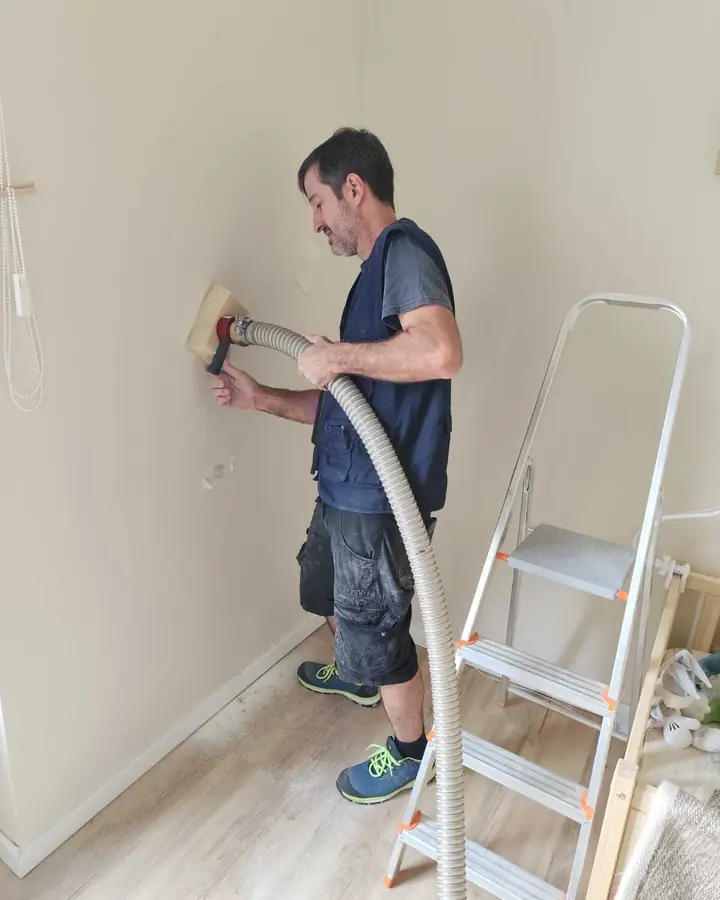
With a cavity
We fill the cavity from inside, through small holes that we seal at the end. You lose no space and the façade stays the same. In an apartment, the machine stays on the street and the hose comes in through a window; on a high floor, we take the machine up in the lift.
€20–45/m² incl. VAT, in 1 to 3 days.

Without a cavity
We build a lining wall against the existing one: metal frame, mineral wool and plasterboard, ready to paint. The thickness depends on the insulation you choose: from about 5 cm with gypsum-and-cork boards, and more if you want to insulate more.
€70–150/m² incl. VAT and painting, in 3 to 7 days.
Before you go ahead with a lining wall
Damp
Insulation does not dry a wet wall. Before insulating, you need to know where the water comes from. There are three common causes, and insulation only helps with one of them.
Fix it first
Rain getting in through cracks, window frames or the roof. It has to be repaired first. Insulating over it only hides the problem.
Needs another treatment
Stains near the floor that climb the wall. It comes from the ground and is treated separately. It is not an insulation problem.
Here insulation helps
Mould in corners and behind furniture, mostly in winter. It forms on cold walls. Insulating warms the inside face of the wall and lowers the risk. Airing the house is still essential.
Before blowing, we check the façade and the cavity. If there is rain getting in, we tell you before we quote. How to tell where the damp comes from →
The process
Free
Technical visit
We check the type of wall, whether there is a cavity and its condition. Your written quote usually follows within 48 hours.
Day one
Preparation
We protect floors and furniture. For capoto, we put up the scaffolding.
Days or weeks
Insulation
Blown-in in 1 to 3 days, lining wall in 3 to 7 days, capoto in 3 to 6 weeks.
At the end
Finish and clean-up
Holes sealed, walls ready to paint or the façade in the colour you chose. We clean up before we leave.
We measure the walls, check for a cavity and tell you what makes sense in your case. The visit is free and the written quote usually follows within 48 hours.
FAQ
Another question? Call us on 210 270 937 or message us on WhatsApp.
If the wall has a cavity, blown-in insulation: in our projects, €20–45/m² with VAT, against €70–100 for capoto and €70–150 for a lining wall. Without a cavity, the choice is between capoto outside and a lining wall inside.
Measure the wall thickness at a window or door: at about 30 to 40 cm it is probably a cavity wall: two brick leaves, an air gap and render on both sides. We blow cavities from 4 cm wide, and wider ones of 15 cm or more too. The age of the house helps, as cavity walls are common from the 1960s and 70s. You only know for sure at the technical visit, where we check with a small inspection camera.
The most complete is capoto, because it wraps the whole façade, including pillars, beams and slab edges. When the wall has a cavity, blown-in gives the best value: in our projects, a median of €38/m² against €70–100 for capoto, without touching the façade. We compare the options in detail in our guide to alternatives to capoto.
In the cavity we blow mineral wool or cork. For capoto we use EPS or rock wool boards. In a lining wall, mineral wool or gypsum boards with cork.
Yes. Blown-in can be done wall by wall, and a lining wall room by room. Many clients start with the north-facing walls or the bedrooms.
First, check whether the wall has a cavity: on the free site visit we drill a small hole and look inside with a camera. If it does, we blow mineral wool in through the façade or from inside, in 1 to 3 days, for €20–45/m² incl. VAT. If it does not, there are two options: capoto on the outside, €70–100/m², or a lining wall on the inside, €70–150/m².
It depends on the insulation you choose. Gypsum-and-cork boards start at about 5 cm per wall; mineral wool takes a little more. The thicker it is, the better it insulates: at the visit we decide with you on the balance between space and insulation. If the wall has a cavity, blowing it from inside takes no space at all.
It depends on the cause. It lowers the risk of condensation, the mould in the corners of cold walls. It does not cure rain penetration or rising damp: those are treated first. At the visit we tell you which one you have.
For capoto, yes: changing the façade of a building needs approval at the owners' assembly, by a simple or a two-thirds majority depending on the work. Blowing the cavity leaves the façade as it is, which often makes things simpler. In an apartment, blowing from inside avoids touching the façade. A lining wall is built inside your home.
Blown-in takes 1 to 3 days on a typical house. A lining wall takes 3 to 7 days, depending on the area. Capoto takes 3 to 6 weeks, with scaffolding up during the work.
What the law says
Portaria no. 138-I/2021 sets the maximum thermal transmittance (U) of outside walls in new or renovated homes. The lower the U, the better the wall insulates. The limit depends on the winter climate zone.
There are exceptions for work with technical constraints. With blown-in, the thickness is that of the existing cavity; with capoto or a lining wall, you choose it. At the visit we explain what each option can achieve on your wall.
| Winter zone | Maximum U |
|---|---|
| Zone I1The mildest. Covers most of the Lisbon and Setúbal region. | 0.50 |
| Zone I2 | 0.40 |
| Zone I3The coldest. | 0.35 |
U in W/(m².°C). Source: Portaria n.º 138-I/2021, Tables 1 and 5. The exact zone depends on the municipality and altitude.
Keep reading
Blown-in insulation
How we fill the cavity, step by step.
Read more →
Capoto (ETICS)
Prices, materials and timings of external insulation.
Read more →
Lining walls and ceilings
Insulating from inside, room by room.
Read more →
What does insulation cost?
2026 prices by technique, from walls to attic.
Read more →

We insulate walls in Lisbon, Cascais, Oeiras, Sintra, Almada and Setúbal
Free visit, quote usually within 48 hours
Don't just take our word for it - hear from those who have experienced the EnergyEase difference.


